

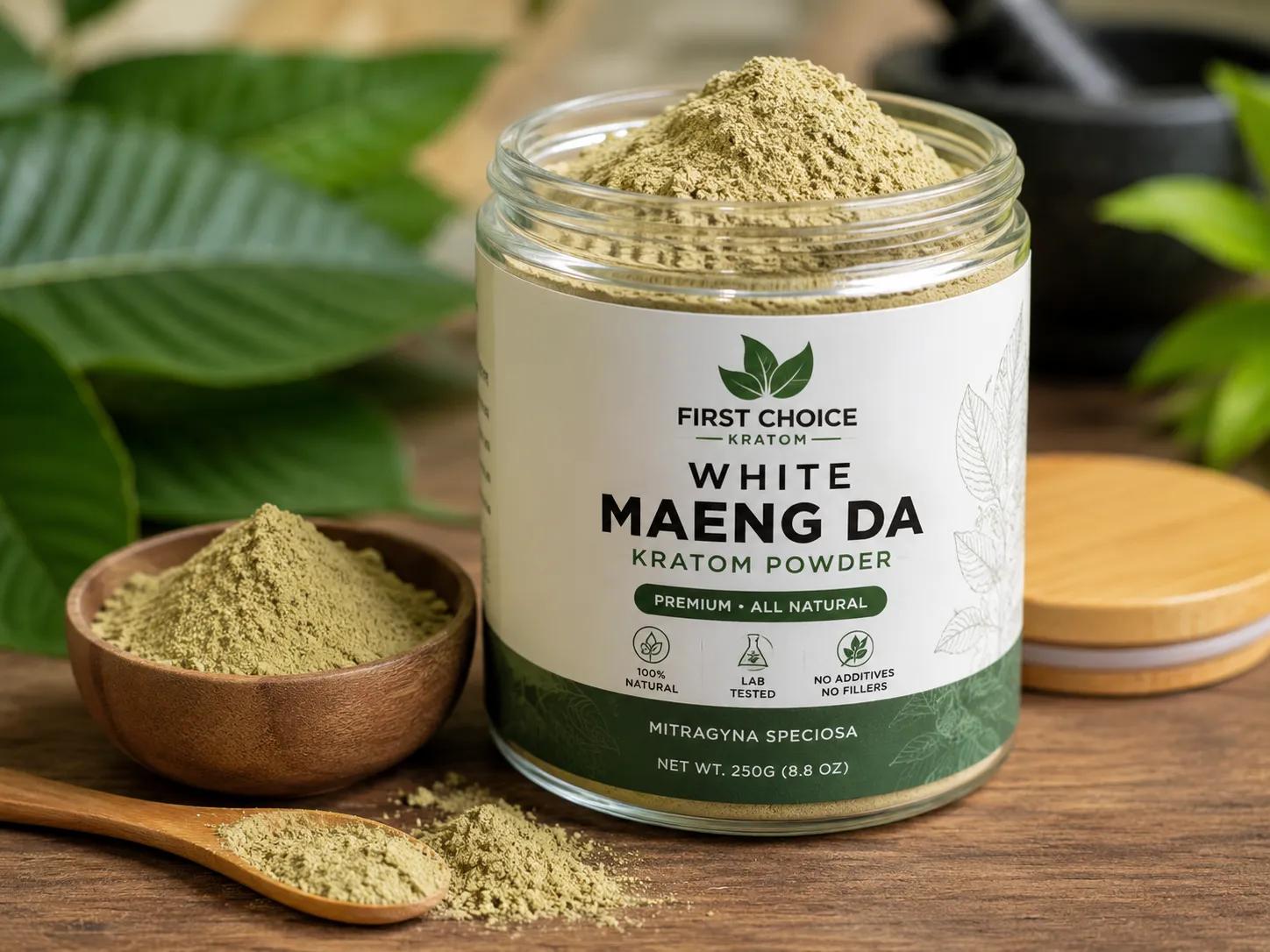
White maeng da kratom powder in a glass jar with product
When people buy kratom online, the biggest challenge is often not finding products—it is deciding which information deserves trust. Online shoppers may see familiar names such as white maeng da kratom, red bali kratom, sumatra kratom, and jong kong kratom, but product names alone do not tell a shopper everything about quality or safety.
Kratom comes from Mitragyna speciosa, a tropical tree native to Southeast Asia. The U.S. Food and Drug Administration (FDA) states that kratom products are sold online and in physical stores, while also warning consumers about potential risks and unapproved medical claims.
The market is also significant. According to the Substance Abuse and Mental Health Services Administration (SAMHSA), about 1.7 million Americans aged 12 and older used kratom in 2021, equal to 0.6% of that population.
For shoppers, the practical lesson is simple: look beyond the product name and evaluate the evidence behind the product.

What Should You Look for When You Buy Kratom Online?
A good online shopping process begins with product transparency. Before placing an order, shoppers should be able to identify what product they are purchasing, how much is included, who sells it, and whether meaningful quality information is available.
One of the most useful documents is a Certificate of Analysis (COA). A COA is a laboratory report that describes test results for a specific sample or batch. Depending on the laboratory and testing program, a COA may include an alkaloid profile and screening for contaminants such as microorganisms, heavy metals, or pesticides.
The important detail is the batch number. A generic laboratory report does not necessarily prove that every batch has identical results. A stronger quality-control practice is to provide documentation that can be connected to the particular lot being sold.
Packaging also matters. Sealed, opaque, moisture-resistant packaging can help protect powdered botanical products from environmental exposure during storage and shipping. However, attractive packaging should never substitute for meaningful product information.
Another important distinction is between natural kratom leaf products and concentrated or enhanced products. In 2025, the FDA specifically took action concerning concentrated 7-hydroxymitragynine (7-OH) products and distinguished those products from natural kratom leaf.
Why Do Lab Testing and Vendor Transparency Matter?
Quality testing matters because botanical products can be affected by contamination or inconsistent manufacturing. The FDA has previously reported kratom products associated with microbial contamination, and the agency has also published more recent recalls involving kratom powder with potential Salmonella contamination.
A real-world example occurred in October 2025, when the FDA posted a recall involving several kratom powder products because of potential Salmonella contamination. The recalled products included Bali Gold, Red Bali, Green Maeng Da, and White Elephant powders.
That example shows why shoppers should not assume that a familiar strain name automatically means consistent quality.
Vendor transparency is equally important. A trustworthy seller should make it reasonably easy to understand the product's identity, packaging, testing practices, contact information, and purchasing terms.
Shoppers should also be cautious about medical promises. The FDA states that there are currently no FDA-approved prescription or over-the-counter drug products containing kratom legally marketed in the United States and warns consumers about using kratom for medical treatment.
This distinction is important for SEO content as well as consumer trust. Describing a product as a botanical product is different from claiming that it treats pain, anxiety, opioid withdrawal, depression, or another medical condition.

How Can You Compare Kratom Products Before You Buy?
Comparing products works best when shoppers use consistent criteria instead of choosing solely by strain name or price.
Names such as white maeng da kratom, red bali kratom, sumatra kratom, and jong kong kratom are commonly used product or regional labels. They can help shoppers organize product choices, but they should not be treated as standardized guarantees of chemical composition or effects.
Batch testing is more useful for evaluating the particular product in front of you. For example, a shopper comparing two products can check whether both have identifiable batch numbers, recent laboratory documentation, clear ingredient information, and appropriate contaminant screening.
Price is another factor, but the cheapest product is not automatically the best value. A low price may look attractive until a shopper discovers that testing documentation, shipping information, or product details are difficult to verify.
Shopping Factor | What to Check | Why It Matters |
|---|---|---|
Product Identity | Strain or product name and form | Helps identify exactly what is being purchased |
Batch Testing | Matching lot or batch number | Connects laboratory results to a specific product |
Contaminant Screening | Microbial, heavy-metal, and other relevant tests | Helps shoppers evaluate quality-control information |
Packaging | Sealed, opaque, moisture-resistant packaging | Helps protect the product during storage and shipping |
Vendor Transparency | Contact details, policies, testing information | Makes the seller easier to evaluate |
Legal Information | State and local requirements | Kratom laws can differ by location |
What Mistakes Should You Avoid When You Buy Kratom Online?
The first mistake is choosing a product entirely because of a strain name. Names can help shoppers navigate a catalog, but they do not replace laboratory documentation or clear labeling.
The second mistake is assuming that every COA is equally useful. A document should contain enough information to identify the tested sample, and shoppers should look for a reasonable connection between the report and the product being purchased.
The third mistake is ignoring enhanced products. Concentrated 7-OH products have received specific FDA attention because 7-OH can be substantially more potent at mu-opioid receptors than mitragynine.
The fourth mistake is trusting medical claims without evidence. The FDA specifically warns against marketing kratom with unproven claims about treating medical conditions.
The fifth mistake is overlooking local laws. Kratom rules can vary by state and locality. The FDA advises consumers to consult applicable state health and law-enforcement authorities regarding local requirements.
Finally, shoppers should not assume that online availability means a product is approved as a drug, dietary supplement, or conventional food. The FDA's current position is that kratom is not lawfully marketed in the United States in those categories.

What Are the Best Tips for Kratom Buy Online Research?
Start by creating a simple checklist before shopping. Confirm the product name, form, package size, batch information, testing documentation, vendor contact details, and applicable local requirements.
Next, compare information rather than advertisements. If one vendor provides a detailed batch-specific COA while another provides only broad statements such as "premium quality," the documentation gives the shopper more information to evaluate.
Shoppers should also read the full product page. Look for ingredient information, product descriptions, laboratory-testing information, shipping policies, return policies, and age restrictions where applicable.
It is also smart to save the product page and COA associated with a purchase. Keeping those records can make it easier to identify the exact product and batch later.
For kratom buy online searches, shoppers should also separate education from promotion. A useful guide should explain what is known, what remains uncertain, and what official agencies say. That approach is more reliable than content that promises guaranteed effects.
Kratom research is still developing. A recent analysis of U.S. National Survey on Drug Use and Health data found that combined past-year kratom use among U.S. adults was about 0.68% during 2021–2023.
That number provides useful context, but prevalence does not establish whether kratom is safe or effective for a particular person. Individual health factors, medications, other substances, and product composition can all matter.

Frequently Asked Questions
1. What should I check before I buy kratom online?
Before you buy kratom online, check the product identity, batch information, available laboratory testing, packaging, vendor transparency, purchasing policies, and applicable state or local laws.
2. What is a Certificate of Analysis for kratom?
A Certificate of Analysis, or COA, is a laboratory document showing analytical results for a tested sample. A useful COA should provide enough identifying information to determine which product or batch was tested.
3. Is white maeng da kratom different from red bali kratom?
White maeng da kratom and red bali kratom are different product labels commonly used by kratom sellers. The names may describe marketed varieties or characteristics, but they should not be treated as standardized guarantees of chemical composition or effects.
4. Is it safe to assume a kratom product is high quality because it is expensive?
No. Price alone does not establish quality. Shoppers should evaluate testing documentation, labeling, batch information, packaging, and vendor transparency rather than using price as the only quality indicator.
5. Is kratom legal everywhere in the United States?
No. Kratom laws can vary by state and locality. Consumers should check the rules that apply to their specific location before ordering because online availability does not necessarily mean a product is permitted everywhere.
6. Are kratom products FDA-approved medicines?
No. The FDA states that there are no FDA-approved prescription or over-the-counter drug products containing kratom legally marketed in the United States. The agency also warns consumers about using kratom to treat medical conditions.
Conclusion
Choosing an online kratom product should involve more than searching for a familiar strain or the lowest price. A smarter approach is to compare product identity, batch-specific testing, packaging, vendor transparency, policies, and applicable laws. Names such as white maeng da kratom, red bali kratom, sumatra kratom, and jong kong kratom can help shoppers navigate product catalogs, but laboratory information and clear labeling provide more useful quality signals. Consumers should also distinguish natural leaf products from concentrated products and avoid unsupported medical claims. Careful research creates a more informed purchasing process and helps shoppers make decisions based on evidence rather than marketing alone.